
The McKenzie River runs through a landscape of forests, small communities, rural roads, and scattered homes. With a river that large nearby, it might seem that firefighting water should be readily available. For McKenzie Fire & Rescue, however, having water in the landscape and being able to deliver it to a fire are two very different things.
The district has relatively few fire hydrants. Some river access points are miles from the properties firefighters need to protect, and others require equipment and personnel to operate safely. Access roads and boat ramps can be crowded with parked vehicles. When a fire is moving quickly, firefighters cannot always spare multiple volunteers to manage water collection while other crews are needed at the scene.
When the River Isn't Enough: A Rural Oregon Fire District Builds Its Own Water Network
McKenzie Valley, Oregon | Lane County
McKenzie Fire & Rescue
A separate infrastructure problem made matters worse. The EWEB Leaburg power canal was drawn down, eliminating or disrupting several established locations where firefighters had previously collected water. An existing resource that the department had depended on was suddenly unavailable.
Rather than trying to solve the problem at one location, McKenzie Fire & Rescue began developing a distributed network of dedicated firefighting water tanks.
The solution: Put water where firefighters need it
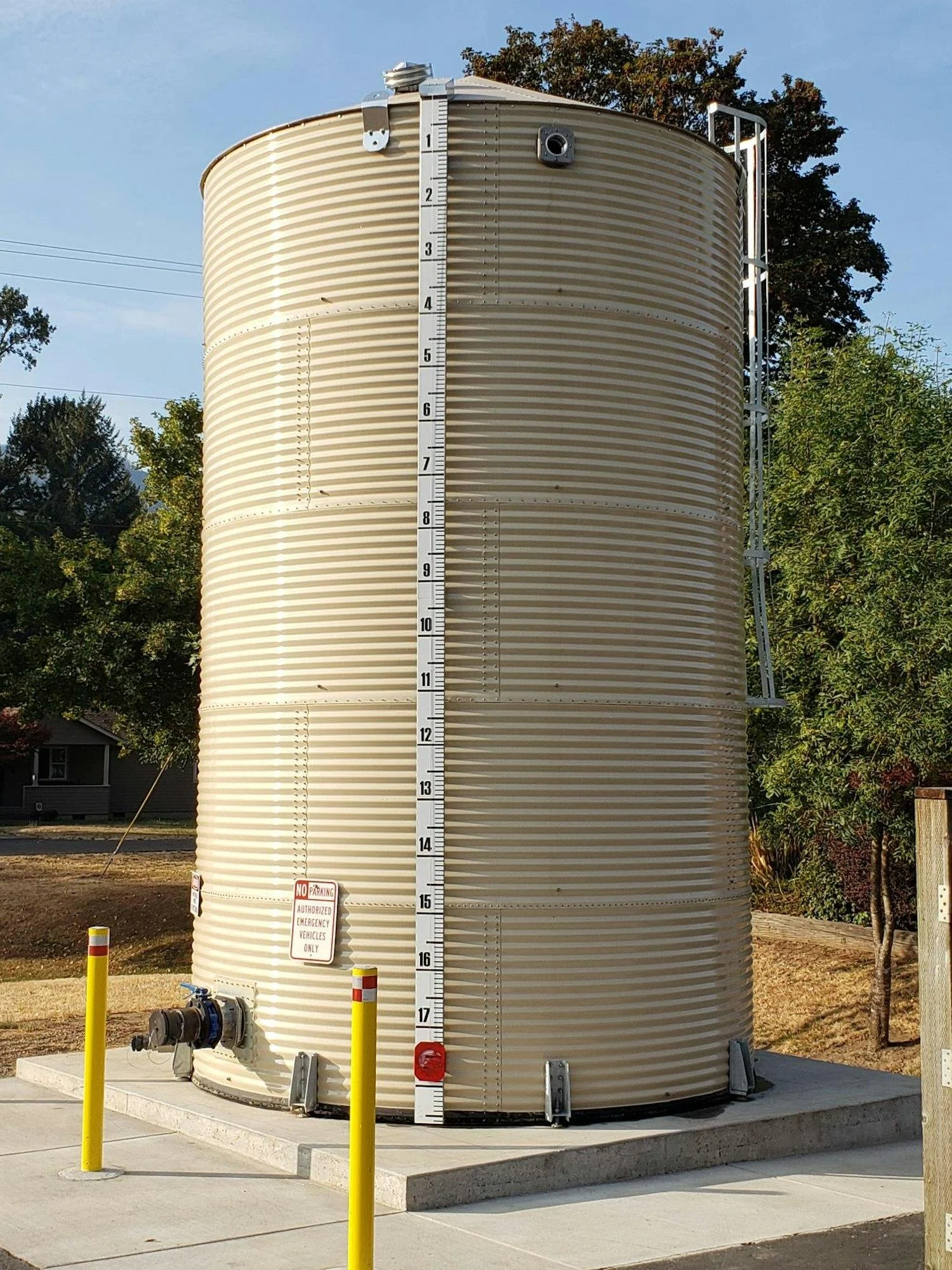
Beginning in 2020, the district installed water tanks at strategically selected locations, including fire stations, churches, and a school.
These were not ordinary residential tanks. The larger installations provide approximately 15,000 to 24,000 gallons of water, with connections designed for firefighting equipment.
The approach addressed several problems at once.
Firefighters would no longer need to send every tender to a distant river access point. Water could be obtained from predetermined, accessible locations. Gravity-fed systems could reduce the personnel required for filling operations. And storage could be placed nearer to neighborhoods or commercial buildings without dependable hydrants.
The district eventually reported seven established tanks, including installations at Camp Creek Church, Walterville Elementary School, Leaburg Fire Station, Vida Fire Station, and other community sites.
The project also created an opportunity for residents to participate. Tanks have visible water-level gauges, and the fire district asks community members to report unusually low levels so maintenance crews can investigate.
Funding the next phase
The 2020 Holiday Farm Fire created additional urgency around emergency infrastructure in the McKenzie Valley.
A subsequent opportunity came through the Planning, Infrastructure, and Economic Revitalization program, commonly called PIER. This program uses federal Community Development Block Grant Disaster Recovery funds administered through Oregon's disaster recovery system.
Lane County became the responsible organization for the fire-suppression tank project.
Oregon's third-quarter 2025 federal disaster recovery reporting identified a $1,073,000 budget and obligation for the Lane County Fire Suppression Tanks project. The original scope called for ten additional water tanks serving McKenzie Fire & Rescue and Upper McKenzie Fire District.
By 2026, the district had announced the completion of two new PIER-funded, 15,000-gallon water tanks. One was placed on Deerhorn Road at milepost 4, and another near Leaburg Lake at the McKenzie River Discovery Center.
Additional sites were being pursued throughout the valley, including locations associated with EWEB, Goodpasture Road, Mt. Hagen Road, and Mill Creek Road.
The unexpected challenge: Finding places to put the tanks
Securing money was only part of the work.
A large water tank needs an appropriate location, practical emergency access, an adequate foundation, and arrangements for filling and maintaining the system. Not every desirable location is publicly owned.
The Deerhorn Road installation depended on cooperation from the Dehne family, which allowed a tank on its property. The McKenzie River Discovery Center provided another location.
These agreements illustrate a part of rural infrastructure development that is easily overlooked: the property owner may be as important to project success as the funding agency.
There was also a change in how the fire district proposed using its grant allocation.
In November 2026, Lane County and McKenzie Fire & Rescue announced public meetings to discuss revising the original project scope from ten water tanks to seven water tanks plus a pumper-tender truck. The proposed vehicle purchase was assigned $595,000 in PIER disaster recovery funds.
The rationale was operational. A truck carrying additional onboard water could complement stationary tanks and allow crews to sustain firefighting efforts for longer periods.
As of November 10, 2026, that proposed scope change was still subject to the public review process. It should not be treated as a completed vehicle purchase.
Community participation without requiring everyone to agree on everything
The project's documented community involvement includes property owners who provided tank locations, organizations that hosted installations, residents who help monitor equipment, and public meetings concerning grant-funded changes.
That is different from claiming that every resident supported every site or expenditure. Public infrastructure projects often require several rounds of coordination even when the overall goal is widely valued.
The McKenzie project also shows why long-term coordination matters. The original work began years before the 2026 installations. Site selection, environmental review, changing equipment needs, and grant administration continued as the project evolved.
What other small communities can learn
McKenzie Fire & Rescue did not wait for the installation of a full municipal hydrant network.
Instead, it developed a practical alternative using available parcels, community partnerships, dedicated water storage, and multiple funding opportunities.
Its success is incremental. Two newly funded tanks can begin serving residents while later installations remain in development.
The broader lesson is that rural infrastructure does not always have to be built as one enormous project. It can be designed as a network of smaller, independently useful improvements, with each phase making the community better protected than it was before.
Fire district and project photographs:
https://www.mckenziefireor.gov/2026-2027-pier-funded-water-tank-update
Existing water tank network:
https://www.mckenziefireor.gov/water-tanks