
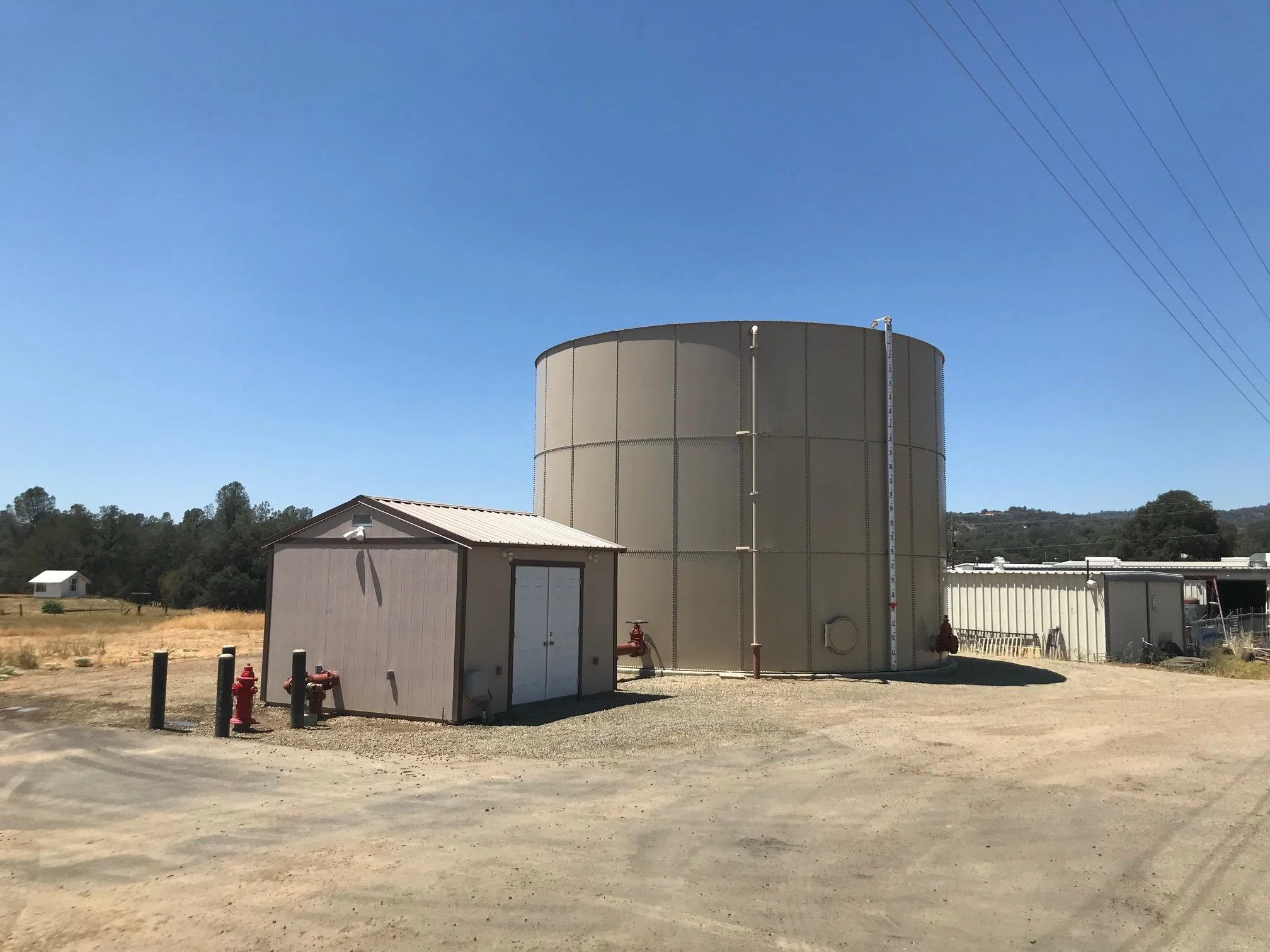
Bootjack Fire & Rescue
In the foothills of California's Sierra Nevada, the unincorporated community of Bootjack faced a familiar rural problem: firefighters couldn't always get enough water to where they needed it, quickly enough. With no municipal government of its own, Bootjack depended on county services, fire agencies, and regional partnerships to address the problem. During a wildfire, every trip to refill a water tender could mean valuable time away from the fire.
The solution was deceptively straightforward. Build a large water-storage tank at the local fire station, connect it to reliable filling equipment, and give firefighters a dependable source of water closer to the homes and countryside they were protecting. What made the Bootjack project exceptional was not just its construction, but how soon the investment was put to the test.
The Fire Came Just Days After the Water Tank Was Ready
Bootjack, California | Mariposa County
From a local problem to a funded project
In 2020, the Mariposa County Resource Conservation District secured approximately $700,000 through California's Department of Water Resources Integrated Regional Water Management program. The project was supported by Proposition 1 water-bond funding.
Instead of asking the small community to finance an entirely new water system, the conservation district partnered with Mariposa County to improve existing infrastructure at Bootjack Fire Station.
The work involved more than simply placing a tank on a concrete foundation. Original project specifications included upgrading the existing well pump, installing high-capacity booster pumps, adding a fire hydrant, constructing electrical controls, and providing backup generator capacity. These improvements were necessary to make stored water useful during an actual emergency, particularly if wildfire conditions disrupted electric service.
A formal agreement between the county and the conservation district established authority for the electrical improvements. Engineering work had to address underground utilities, water lines, power requirements, and the connection between the station and storage system.
California's official grant accountability records ultimately listed the completed project at approximately $953,303 in total cost. Those records identify the project as completed, fully paid, within budget, and within its approved scope.
The wildfire that changed everything
The tank was brought into service in July 2022. Only days later, the Oak Fire broke out in Mariposa County, eventually burning more than 19,000 acres and destroying numerous structures.
The newly installed system immediately became part of the firefighting response.
According to the California Department of Water Resources, the installation allowed two water tenders to refill in approximately ten minutes. The average turnaround time for water tenders traveling between the fire and their water source fell from about 60 minutes to 30 minutes.
By August, the Bootjack tank had supplied approximately 500,000 gallons for firefighting and cleanup operations. County fire personnel credited the system with helping protect homes.
For a small community, the difference was substantial. The project didn't create additional firefighters or eliminate wildfire danger. It enabled existing firefighters and equipment to spend less time retrieving water and more time putting it where it was needed.
Community support and the complications behind the scenes
The documented collaboration involved the county public works department, the resource conservation district, state water officials, and local emergency-response personnel.
Public records show that work extended well beyond the visible tank. Electrical upgrades, coordination of utility connections, backup power, and interagency agreements were essential pieces of implementation.
The available records do not establish whether the project had unanimous local support or whether residents raised objections. What they do demonstrate is that a small unincorporated community successfully benefited from a project administered by organizations with the authority and capacity to handle funding, engineering, procurement, and construction.
An additional result emerged afterward. Mariposa County used the Bootjack experience to justify expanding dedicated firefighting water storage elsewhere. By 2025, the county had completed additional tanks supported by FEMA funding, turning one successful installation into a broader countywide strategy.
A lesson for other rural communities
Bootjack demonstrates that emergency preparedness does not always require a multimillion-dollar station or a complete redesign of a water network.
Sometimes the answer is a strategically located tank, the infrastructure needed to make it operational, and a partnership capable of carrying the project from funding through construction.
For communities without municipal governments, that partnership is especially important. The residents may know exactly what is needed, but another organization may need to become the applicant, contracting authority, or project administrator.
In Bootjack's case, the investment was complete just in time to prove why it mattered.
Original project: California Department of Water Resources
https://water.ca.gov/News/Blog/2022/Sept-22/DWR-Funded-Project-Provides-Support-to-Firefighters-During-Oak-Fire
Project administrator: Mariposa County Resource Conservation District
https://www.mcrcd.net/
Funding and accountability: California Natural Resources Agency
https://bondaccountability.resources.ca.gov/Project/Details/32945/?PropositionPK=48