
Medical Springs, OR
Four Grants and a Retired Military Truck: How a Tiny Oregon Fire District Rebuilt Its Water Supply
Medical Springs, Oregon | Baker and Union counties
The department was entirely volunteer-operated. Its members were responsible not only for their own district but also for helping neighboring agencies through mutual-aid agreements.
The problem was a 42-year-old water tender that had become increasingly unreliable. It frequently broke down, required expensive repairs, and was difficult to operate on steep rural roads.The truck's outdated transmission made matters worse. Only a handful of volunteer firefighters were comfortable driving it, creating a serious operational bottleneck.
The department's need became especially apparent during a wildland fire when the incident commander, one of the few people qualified to operate the truck, had to leave his command responsibilities to drive it up a steep hill.
The issue was no longer simply the expense of maintaining an old vehicle. It had become a question of whether the department could reliably deliver water without disrupting the rest of its emergency response. A solution that didn't require buying a new fire truck. A conventional new water tender would have represented an enormous financial undertaking for a district with so few residents.
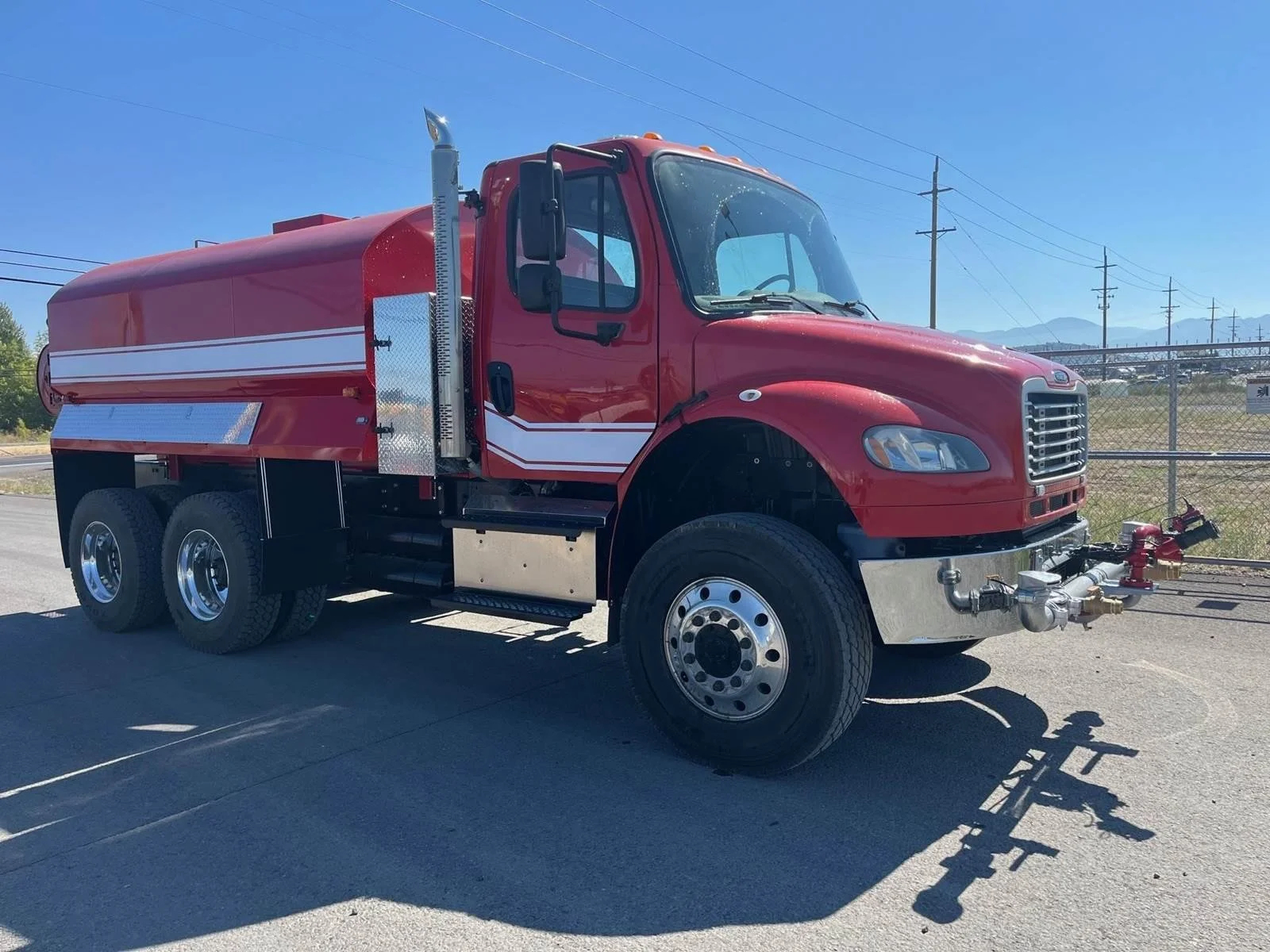
Instead, Medical Springs acquired a retired military truck through an Oregon Department of Forestry program for a nominal fee. The vehicle was a 2008 Freightliner with fewer than 6,000 miles and an automatic transmission. It provided a suitable platform for conversion into a firefighting water tender. The department then needed to finance the conversion, including a new tank, necessary mechanical work, and equipment that would meet applicable firefighting standards. Rather than depending on one large funding award, it assembled four separate grants.
How the project was financed
The documented grant awards were:
USDA Rural Development Community Facilities Program: $26,250
Wildhorse Foundation: $20,000
Collins Foundation: $25,000
Northwest Farm Credit Services: $3,500
Together, the grants totaled $74,750.
The Oregon Department of Forestry helped make the project affordable by providing access to the surplus truck. Randco Tank contributed vehicle-overhaul work, while Quality Sign and Design was identified as a partner for the vehicle graphics. The resulting vehicle was equipped with a new 3,000-gallon water tank and converted from a transportation truck into a water tender. The completed apparatus met National Fire Protection Association standards and was better suited to the terrain that the department routinely encountered.
The complications were practical, not glamorous
The biggest obstacles had little to do with finding an innovative firefighting technique. The department needed a truck that ordinary volunteers could operate. It needed to climb steep roads. It needed to be dependable enough for mutual-aid assignments. And it needed to meet safety standards despite being constructed using a surplus vehicle. Each requirement narrowed the available solutions.
Funding was another challenge. None of the four grants alone would have provided the full amount ultimately assembled for the project. Combining public and private funding allowed the department to complete a more substantial conversion than it could have purchased through a single award. There was also the work of coordinating contributors. Obtaining the chassis, securing grant awards, arranging mechanical work, purchasing and mounting a water tank, and preparing the vehicle for service required different organizations to contribute at different stages.
Volunteer firefighter and grant writer Judy Whitley helped lead the funding effort. The USDA's published account credits the combined contributions of funds, time, and expertise for making the project possible.
Did the community support it?
The documented evidence of support comes primarily from the volunteer department and the funding partners rather than a recorded community vote. The district relied on its own volunteers, a federal funding agency, three additional grantmakers, and businesses providing specialized services. There is no documented referendum or public-opinion survey in the USDA project account. It would therefore be inaccurate to claim unanimous resident support. What can be established is that several independent organizations considered the need sufficiently important to contribute resources toward solving it.
What changed
Medical Springs received a reliable, 3,000-gallon firefighting water tender that could navigate its remote service area and strengthen mutual-aid capabilities. The project also reduced dependence on a highly specialized old vehicle that only a few volunteers could operate. The USDA documented the completed project in November 2016.
A lesson for other rural fire districts
Medical Springs demonstrates that grant funding does not always have to pay for an entire new vehicle or building. A district may be able to obtain a usable surplus asset through one program and use smaller grants to turn it into the equipment that residents actually need. It also shows the value of defining the operational problem before pursuing money. The need wasn't merely a newer truck. It was a dependable, standards-compliant water supply vehicle that volunteers could drive on difficult terrain.
That distinction helped shape a more affordable solution. For small rural districts, the most effective project may be the one that combines existing equipment, outside expertise, and several attainable funding sources rather than depending on a single major grant.
Original USDA project report, with photograph:
https://www.rd.usda.gov/files/success-story/OR-CP-CF-MedicalSpringsFire-11.28.2016_0.pdf
Funding agency: USDA Rural Development
https://www.rd.usda.gov/
Equipment partner: Oregon Department of Forestry
https://www.oregon.gov/odf/
The Medical Springs Rural Fire Protection District serves an exceptionally large area for such a small department. At the time of its 2016 equipment project, the district protected approximately 135 residents and 60 homes scattered across 125 square miles of eastern Oregon.